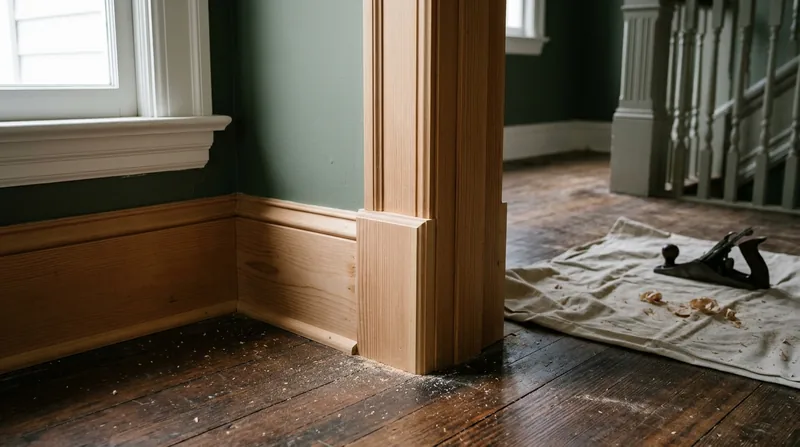




Finish & Trim Carpentry in Tacoma is the craft that separates a house from a home. Whether you own a 1920s Craftsman bungalow in the North End with original Douglas fir trim, a Queen Anne Victorian in the Stadium District, or a newer two-story home in Gig Harbor, tight miters, scribed fits and even reveals are what set a finish carpenter apart. Tacoma's residential stock spans a century of building styles, each with its own trim language and material character. We install casing, paneling, wainscoting and custom trim that respects the original detail and lasts as long as the house does. The same carpenters do your work from start to finish, and we explain what we're building and why.
Why Finish Carpentry Matters in Tacoma's Historic and Newer Homes
Tacoma's architectural heritage demands precision. A Stadium District Victorian needs crown molding that honors its original plaster details. A North End Craftsman bungalow's casings and baseboards carry the visual weight of the whole interior. Even a 1990s or 2000s home on South Hill benefits from custom trim work that tightens the transition between rooms and materials. Poor finish carpentry shows immediately: gaps at miters, inconsistent reveals, panels that don't sit flush, and door jambs that don't square up. Good finish carpentry is invisible because it simply fits.
- We install door and window casing with consistent reveals and tight miters that hold their joints over decades.
- We fit crown molding and baseboard around walls, columns and returns using coped joints and scribing to follow uneven plaster and old framing.
- We build and hang wainscoting and wall paneling in period-correct profiles or modern styles depending on the home's character.
- We install interior trim packages including casings, baseboards, shoe molding and corner blocks as a coordinated system.
- We hang interior doors and fit door jambs and casings so the door closes smoothly and the frame sits plumb and square.
Finish carpentry is where the bones of a house become livable rooms, and it's where the details that catch your eye every day are decided.
Key info: Tacoma's old-growth Douglas fir and western red cedar trim from the 1900s-1930s era is harder and denser than modern lumber. It machines differently, holds paint better, and tolerates moisture swings that would check or warp newer wood. Working with it requires hand tools, patience, and an understanding of how the grain behaves.
How We Approach Finish Carpentry Work in Tacoma
Every finish carpentry job starts with understanding the room's geometry and the home's architectural language. We visit the site, take measurements, and identify the existing trim profiles, paint colors and material character. We source lumber that matches or complements what's already there. We plan each run of casing, molding or paneling so that joints fall in logical places and reveal widths stay consistent. Then we cut, fit and install with hand and power tools, using scribing, coping and shimming to handle the uneven walls and old framing that are normal in Tacoma's historic housing stock.
- We measure the room in detail and photograph existing trim to document profiles, joints and paint color.
- We source lumber from local suppliers, matching species, grain and color to the existing work or the client's design intent.
- We cut all pieces at the shop or on site, using a miter saw for crosscuts and a table saw for rips, then test-fit before installation.
- We install blocking and backing boards as needed so that trim fastens to solid wood, not drywall alone.
- We hang and shim all pieces plumb, level and square, using finish nails or screws depending on the application and visibility.
- We caulk joints where trim meets walls or other trim, then sand and paint or stain according to the homeowner's finish choice.
The result is trim that looks built, not installed, and that will still be straight and tight twenty years from now. See also our work on crown molding and baseboard installation for more detail on these specific applications.
Local example: A 1920s bungalow in Proctor had original 4-inch baseboards and 2-inch casings in clear old-growth fir. The homeowner wanted to match the profile on new sections after a bathroom remodel. We had the profiles milled at a local shop, fit the new sections into the existing runs using scarf joints, and finished everything with the same paint. The joints are invisible unless you know to look for them.
| Approach | Description | Best for |
|---|---|---|
| Scribing and Coping | Trim is fitted to follow the exact profile of walls, plaster, columns or existing molding by hand-shaping the edge with a coping saw or plane. | Rooms with uneven or wavy walls, inside corners where two moldings meet, and situations where gaps cannot be hidden. |
| Miter Joints | Two pieces of molding are cut at 45 degrees and joined end-to-end so that the grain and profile flow across the corner without interruption. | Outside corners where the joint is visible and grain continuity matters, and where coping would be impractical or weaker. |
| Scarf Joints | Two pieces of molding are cut at a long angle and fitted end-to-end along a run so that the joint is nearly invisible when painted. | Long runs of baseboard or casing where a single board would be too short or where a butt joint would be visible. |
| Built-Up and Custom Profiles | Multiple pieces of molding are stacked and combined to create a profile that matches or exceeds the original, or a new design based on the home's character. | Historic restoration, architectural detail work, and custom design where off-the-shelf molding does not exist or does not fit. |
Finish & Trim Carpentry Cost in Tacoma: What to Expect
Finish carpentry pricing in Tacoma depends on several concrete factors: the profile and species of molding, the linear footage of trim to be installed, how much of the existing wall surface is plumb and square, and whether scripting, coping or custom milling is required. A straightforward casing job in a new construction home with square walls runs at the lower end. A historic restoration involving scribed crown molding around plaster walls and custom baseboard profiles costs more because the work is slower and more precise. We recommend getting 2 to 3 estimates so you can compare not just price but the approach and the quality of the finish carpenter's prior work.
Pricing for finish carpentry typically starts at around $550 for smaller projects like a single room's casing and baseboard, and scales upward based on linear footage, complexity and material cost. Custom paneling, wainscoting and built-up molding run higher because they involve more material and labor. A whole-house trim package can range from $3,500 to $8,000 or more depending on square footage and detail level. See our full pricing overview for more detail, and call us at (253) 498-6752 for a free, no-obligation estimate specific to your project.
Finish & Trim Carpentry Near Me: What Tacoma Homeowners Should Know When Hiring
Finding a finish carpenter in Tacoma or nearby areas like University Place, Lakewood, Gig Harbor and Puyallup requires looking at three things: insurance and bonding status, the quality of the carpenter's past work, and whether they understand your home's architectural style. Ask for references from recent jobs, and if possible, visit a completed project to see how miters are cut, how reveals line up, and how the finish holds paint or stain. Understand that some trim work, especially if it involves structural changes or alterations to door openings and walls, may require a permit from the Tacoma building department. Your contractor should be able to advise on whether a permit is needed for your specific job and help coordinate with the city. Also check whether your homeowners association or historic district has any design guidelines that affect trim color, material or profile.
- Verify that the contractor is fully insured with general liability and workers compensation coverage.
- Ask for a written estimate that describes the molding profile, the linear footage, the finish, and the timeline.
- Request references from at least two recent finish carpentry jobs and follow up with the homeowners.
- Discuss whether your project requires a permit by contacting the Tacoma building department or asking the contractor to advise.
- Check for HOA design guidelines or historic district restrictions that may govern trim color, material or style in your neighborhood.
A good finish carpenter explains what they're doing and why, shows you samples of molding and paint colors before starting, and stands behind their work with a warranty on joints and finishes. Contact us for a free estimate and to discuss your project in detail.
Finish & Trim Carpentry in Tacoma: Pricing Guide
| Service | Price | Details |
|---|---|---|
| Single room casing and baseboard | Starting at $550 | Includes door and window casings, baseboard and shoe molding, finish nails and caulk, painted or stained |
| Crown molding installation | Starting at $750 | Linear footage and profile complexity drive cost; scribing around uneven walls and plaster increases price |
| Wainscoting and wall paneling | Starting at $1,200 | Cost scales with square footage, panel profile, blocking requirements and finish coat complexity |
| Custom built-up profiles or restoration trim | On estimate | Milling, sourcing old-growth or specialty lumber and hand-fitting historic detail requires on-site assessment |
| Travel | Included | No mileage fee or travel charge for Tacoma and surrounding service areas including Gig Harbor and Puyallup |
| Free estimate | No charge | Response within 24 hours at (253) 498-6752, no obligation to book work after estimate |
Indicative pricing, the exact cost depends on square footage, finish, and site access. Free personalized estimate within 24h at (253) 498-6752.


